

NO SPOILERS!
This is kinda offbeat post on this blog, but it sure is interesting. You will need to watch the scene first, and may even have to refer to it repeatedly while reading, as I’ll keep pointing to certain specific moments in the scene through time stamps.
Prologue
I was quite young when I first watched this film. I could not understand why it was so special and why was it being held so high! But, I was anyway proud like any other Indian for it had bagged multiple Oscars for AR Rahman, Gulzar and Resul Pookutty. It was only when I got serious about films and the medium, I re-watched it, and found it quite astounding! Every great piece of cinema, certainly demands a level of maturity and cinematic understanding from the audience. It was one of those rare moments when I was thankful that I had grown up.
These Memorable Shots
I was taking the Masterclass from Martin Scorsese on Filmmaking, and in a particular lesson he talked about how in his childhood he saw some great movies that ran in theaters at those times. Not verbatim but he says, ‘this is weird, even though I never understood what some of the shots in those movies meant, I somehow remembered some selective miraculous images that appeared on screen, like they have been ingrained in my brain’. And I couldn’t help but relate brutally! Shots of Mohan Bhargava & the fakir from Mr. Gowariker’s Swades, dancing on a hillock with the clear blue sky as the backdrop, while Mohan points to a remote settlement and evocatively asks: ‘door woh jaane kiska gaanv hai?’, is one of my earliest film memories! There are many, from good ones and bad, maybe a couple from Lagaan, the one where Bhuvan affectionately flicks Gauri’s earring, as he confesses: ‘maine pyaar tujh hi se hai kiya!’ , is also the one on top of my mind as I draft this post here. Maybe, I forgot the ones from bad films, or made myself forget, who knows!?

Coming to the point, one such memorable shot is of Jamal and Latika from this particular scene that I will attempt to dissect today.

When I re-watched it, I knew there was something significant happening here, but I needed to watch it again and again in order to, say, demystify things. So let’s delve right in. Slumdog Millionaire, directed by Danny Boyle from a screenplay by Simon Beaufoy, based on the novel Q & A by Vikas Swarup.
The Structure Itself
I have always admired the way Simon Beaufoy constructs his highly taut screenplays. This work of his and also including 127 Hours, Everest are all beautifully written screenplays. In this particular film, he uses the classic flashback structure wherein one character is narrating a story to the other, event-by-event, and as he narrates the screenplay visually shows us how that particular event took place. In this film it is primarily done through a quiz game show. I experimented with the same structure in my film Delta, and found out that it is quite an efficient technique to make the exposition feel organic, especially if the story has a large time canvas. It is a lovely condensing tool, this method of exposition.
But how does he write this particular scene? Let us look at how it turned out in the screenplay first.
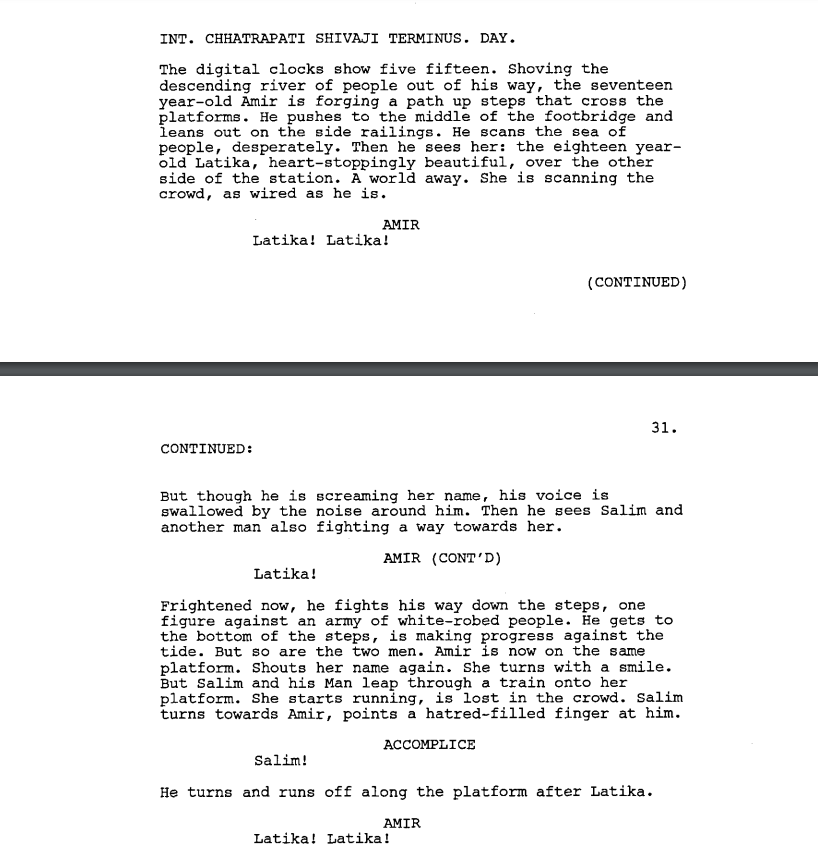
For context: Jamal is played by Dev Patel, who was named Amir in the screenplay. Freida Pinto is Latika, and Salim, Jamal’s elder brother, who abducts Latika towards the end is played by Madhur Mittal, who by the way also played Tito, the sardar kid in children’s TV show Shaka Laka Boom Boom.
Certain things are quite evident from the screenplay excerpt that I put up here, one of which is: the scene has been significantly changed although the purpose and the crux remains the same. There are also some key phrases here, which I would like you to keep a note of: sea of people, a world away, progress against the tide. These key phrases will come in handy for further analysis.
The final scene however uses the midpoint style, one of whose earliest proponents was Syd Field, which he proposed in his book Screenplay: The Foundations of Screenwriting. In this particular style of constructing either a scene or an entire plot, the story hinges over a single, significant midpoint, which as the name suggests comes exactly in the middle. It divides the scene in two halves separating the tension, the mood and even the style used. The midpoint is any event or moment that flips the narrative. The total duration of this scene is 1:20, at about 0:40, which is the exact middle, the scene transforms from a slow romantic encounter to a high paced abduction sequence. If we delve deeper, we can also mark the Plot Points I and II, which are the two moments here, that carry significance. Plot Point I occurs at 0:20, when Latika notices Jamal and Plot Point II occurs at 0:52, when Salim gets hold of Latika.

Also noticeable is the subtle brilliancy of dialogue writing, the same word ‘Latika’ when he shouts for the first two times is for when he wants to grab her attention, the next time he shouts her name is for driving her attention to Salim closing in on her. (0:13 & 0:37) With minimal dialogue, the scene, even just on paper, tells about happenings of the entire event quite efficiently. Minimalist!
Elements of Direction
The primary job of a director is to interpret the screenplay and use various resources available at his/her disposal to translate the text to visuals. He/She does this by planning and designing the shots, their camera angles, moderating the acting performance, staging, blocking and lastly fixating the tone for the film or in this case, the scene. Danny Boyle, who won an Oscar and numerous other accolades for Directing, dons all of these hats quite flawlessly!

The most obvious inspiration of shot-taking comes from the screenplay itself. When a director reads the screenplay, he/she has sequences of images running in his mind, initially these are bleak and blurred, but they evolve once the process of pre-production reaches its completion and the film is about to enter principal photography. But, there is also a lot of improvisation that takes place on the location itself, since things might not actually go according to the plan, which makes directing a kind of instinctive job as well. Boyle uses several key phrases from the screenplay(which we noted) to visualize and execute his shots:

‘Sea of People’ : Boyle frames his actors through passing people and trains, visually conveying how busy the station actually is, this also creates a sense of confusion among the audience who hinge on the thought that if Latika and Jamal would actually be able to see each other or not. 
‘A World Away’ : Use of long lenses, technically known as telephoto lenses with higher focal lengths, helps Boyle convey a sense of distance between both of his characters. 
‘Progress Against the Tide’ : A fast paced tracking shot is designed with Jamal moving in one direction, and rest of the people moving opposite him. He tries to progress against the tide of both the ‘sea of people’ and the passing time. Boyle uses the dramatic question: ‘will Jamal be able to reach Latika before Salim takes her away?’ to create tension.
Staging is assigning positions for the actors in the scene. Since Latika’s inaccessibility for Jamal when Salim poses a threat of abduction is one of the factors necessary in the scene for creating drama, Boyle decides to stage Jamaal on a foot-over bridge, while Latika is below him on a platform. He sticks to the screenplay on this decision of his. However, it is important to note that, the difference in altitude here is not intended for establishing power dynamic of characters, as it generally is, the need is more logistical in this case.
When it comes to framing, Boyle mostly makes obvious decisions, the one that can be pointed out here is how he frames Salim when he spots Latika and runs after her: in extreme low angle, which makes him appear like a dominant threat.

The film had regular use of Dutch tilts, to show the twisted, crooked world of the film. When it comes to tone, it shifts to a high paced chase sequence involving elements of thrill from a subtle romantic start. The shift of tone is noticeable at the midpoint. The acting is kept subtle. Visuals are heavy on the warmer colour tone to represent the quintessential foreign interpretation of ‘Indian weather’ and also made quite chaotic through handheld camera movements which begin post midpoint, imparting a sense of realism.
Controlling the Pace through Editing
While the screenwriter is responsible for designing the sequence of scenes, an editor juxtaposes the individual shots in those scenes. Chris Dickens, who edited this film, won an Oscar.

If you observe the timeline of edit closely, you will notice that the shots get denser in the second half of the scene. Which means, the editor cuts faster in the second half with an intention to increase the pace of the scene, and impart a sense of urgency. Although both the halves take forty seconds each, the latter part feels faster. It is no less than a marvel, that how film medium has managed to alter the pace of time, well at least provide an illusion of the same.
The Sound
I’ve read at many places that sound constitutes for about 50% of a film, ardent audiophiles claim it is 60%, while the remaining 40% is reserved for visuals. Apart from quantitative differences in opinion, one thing seems unanimous: sound is really important. David F. Sandberg, an acclaimed filmmaker, put a video on his YouTube channel ‘ponysmasher‘, in which he showed that audiences can sometimes live with mediocre video quality but the audio has to be good, if its not, the content becomes unbearable.
The great AR Rahman composed music and background score for this film, he also won two Oscars of which one he shared with Gulzar. Also, not many know about this person, but sound designer Resul Pookutty also won an Oscar for Sound Mixing with two of his British counterparts. So the contribution in sound department for this film has been heavily Indian.

Sound Mixing is the technique of adjusting volume levels of various sounds that constitute a scene. The scene starts with diegetic sounds from the station but as Jamaal notices Latika, soft strings take over creating a subtle romantic mood. Again, when Salim is spotted by Jamal, the noise from station takes over. Gradually, the music turns into an Indian classical fusion, which is high on pace and quite suitable to the new mood, like with editing, number of instruments used post midpoint increases like the number of cuts. I suggest you to re-watch the scene now, this time paying attention to the sound.
Epilogue
Like a food dish, a film too has various elements which come together with an intention to provide emotional satisfaction to the audiences’ taste buds. These elements are contributed by various departments, all of whose amounts are curated by one single person: the director, he/she is the one who decides what qualifies to become a part of the film and what does not. This dissection for me, was an attempt to make you understand what all goes inside making a scene. This is just one of many scenes that come together to form a film. If the audience has proper awareness, they can tell the difference between something that is done right and something that has elements casually thrown in. This audience, when informed, would aid budding artists, and guide them to the right path, which is: making good films. Informed audience raises the bar for storytelling, a quote from Michael Tucker, is something I use, to end mostly all my blog posts with. So, I hope you liked this dissection I performed. Please subscribe to the blog through email by scrolling down to the end of the page. Share this post with your fellow film lovers, and please let me know of any suggestions/feedback/thoughts through the comment section below. Until next time! : )

 Unobjective by Ravish Pathan
Good job and keep it up۔۔۔۔I wish you from my heart for your Bright future my dear student۔۔۔۔۔۔۔۔۔
LikeLiked by 1 person
Thank you sir! Means a lot. : )
LikeLiked by 1 person
It was a very well written blog. Didn’t realise that a single scene could have that many elements to pay attention to.
The scene was dissected beautifully. I really liked how various aspects of it were elaborated upon. (I had that “Hnmmm” “Oh” face while reading the blog.)
Well, not sure if I will be able to pinpoint or be critical about how\why a particular\scene is the way it is -THIS beautifully- but I really enjoyed reading this analysis.
Looking forward to reading more blogs.
LikeLiked by 1 person
Thank you for a detailed response, please keep reading! 🙂
LikeLiked by 1 person